I Who Have Never Known Men, Jacqueline Harpman, 1995
As written in Sophie Mackintosh’s Afterword, Jacqueline Harpman was a Jewish woman from Belgium who fled with her family during the second World War. This information sheds light on why Harpman had imagined an apocalyptic universe in which forty caged women are incidentally freed into a world where there is no one else alive. I’d like to start this review with a quote from Mackintosh’s Afterword: “These situations of confinement, of cruelty, of hopelessness, are not without precedent—we’re kidding ourselves if we think of these cruelties as one unique to a fictional, alien planet” (page 171). Harpman took the horror of the caged person and twisted it on its head to show how humanity perseveres in those who are imprisoned.
The story begins with an unnamed narrator in her old age deciding to recollect on the strangeness of her existence. Strangeness is the claim she makes about her own life relative to those before her. She is deciding to write this novel, deliberating a bit on memory, and on grief, and on the merit in discussing the experience of any human, which she believes to be important (5). We are repeatedly asked philosophical questions such as these, which must be Harpman’s purpose. In fact, this is a novel that is driven through philosophical ideas more than through plot. Not much happens in the plot—there is an apocalyptic landscape, and a group of women surviving, but what the pages do best is ask us to think about what a human being is when it is stripped of all manmade constructs such as time, marriage, money, privacy, and entertainment.
I’d like to say Harpman arrives at the conclusion that at our most rudimentary, we have only companionship and imagination. The unnamed speaker is the only one of the forty women in her cage who has no memory before the event that had them imprisoned. They surmise that it was a mistake she was included, as she was the only baby among thirty-nine women. The women have memory of life before imprisonment—memory of family, memory of men. The speaker, on the other hand, only knows the cage, the 39 women she’s caged with, the rations of food they’re given, and the few male guards who pace around the cage with a whip but have never engaged with them.
In perhaps the most whimsical and imaginative sequence, the narrator reflects on herself in adolescence before having been freed. She was completely isolated inside herself, her greatest pastime being to fantasize about the youngest male guard subduing her, the climax of which she described as “an immense sensation [surging] through [her], an overwhelming eruption, an extraordinary burst of light exploding inside [her]” (page 10). What this does is pose the first of many big questions—is arousal innate, and, if yes, where does that position men in relation to female survival?
The novel’s title “I Who Have Never Known Men” may be slightly misleading, as the story isn’t quite a dystopia without men. The women are in a world where there are no other women, either, though men did exist in the world before capture and are positioned as guards after capture. To really confuse my initial theory that this is a world where women have been captured by men, the women find many bunkers through the years of exploration after they escape, some of which hold 40 men instead of 40 women. So there goes the theories about women being caged by men, as men, too, are caged by men.
Harpman makes a bit of a Gilgamesh point while the women are in the cage. As there are no markers of time (which is a major point of the novel, how time is not necessary if you are truly alone), it is believed they are trapped for around 12 to 15 years, and that is judged only by the assumed age of the narrator. The narrator observes how they regularly discuss their manner of cooking, as if they have the privilege of choice. She says “I was surprised at how much they had to say, the passion with which they repeated the same thing in ten different ways so as to avoid accepting that they’d had absolutely nothing to say to each other for ages. But human beings need to speak, otherwise they lose their humanity” (page 21). This makes me think of Enkidu, who needed to learn language in order to be civilized. The women’s desire to continually communicate with one another is the first of many symbols of hopefulness that the women carry with them through the nightmare they are stuck in. To Harpman’s point, you would think you would lose all hope in a situation such as this, but, as the women show, there is always hope as long as there is connection.
The women are freed when there is a loud siren, no one can tell from where or how (as they have no memory of being captured and no understanding of why this is), at the precise moment the guards are routinely opening the hatch to feed them. As soon as the alarms sound, the men run and are never seen again.
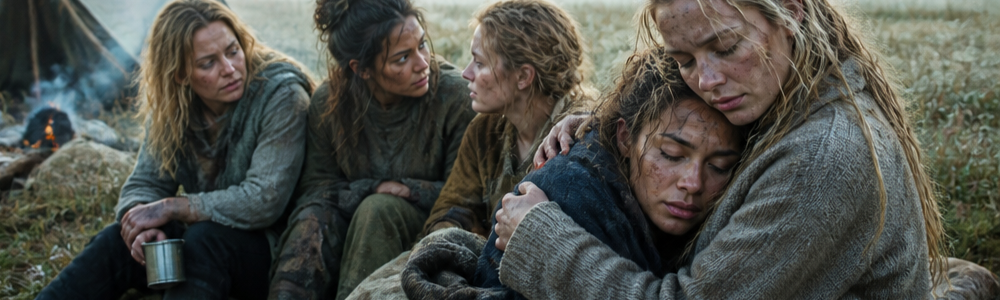
Led first by the speaker, the women too leave the cage. For the first time since their imprisonment, they see the sky (page 49-55). There is this beautiful paragraph of their closeness, “They huddled together, a small, terrified group in the middle of an unknown land. After the familiarity of the cage, the forty women clung to one another, disoriented by the vast stillness from which nothing emanated” (page 56). It is even more touching (no pun intended) when you realize the women have not touched in years, as it was off limits. As soon as they are free, their immediate response is to huddle.
The question of touch is my favorite in the novel. The speaker, who during adolescence understood the sensation of sexual arousal without identifying its name, never becomes fully open to physical touch, though the women desire it in such that some couple as sexual partners. It seems that Harpman may be implying the desire to fantasize about touch is innate, but being comfortable with doing so is taught. Or, in another theory, Harpman may be questioning if the craving for physical touch is forged in childhood. Our speaker, who was never touched as a child, has only a few rare moments of desiring closeness with the women, and is punished by the horrifying sound of the whip when she acts on it in the cage.
In the years after escape, many of the women fall ill, and it is the speaker’s job to take them out of their misery, as none of the other women are able to commit murder coming from the world before capture which taught them murder was horrific. In these last moments, the women ask to be held, and the speaker does so but lacks the understanding for it. Though the narrator is not from our world, and can’t understand relationships the way we do, I still consider her a fairly reliable narrator, as she has taught herself logic and very often expresses her awareness of not being able to understand relational things that the other women naturally do.
Despite the narrator’s lifelong isolation, the novel is profoundly about connection. Even at the many moments of the narrator assisting the women with suicide by sticking a knife into their chest, she says “I know at that moment, they loved me…We became strange accomplices during their last moments, when I was the chosen companion, the one who would unravel their incomprehensible fate…and nod my head confirming that it was all over, that the sick woman’s suffering was at an end” (page 108). They would then wrap the dead woman in a blanket, the “newest and best one [they] had” (page 108).
With this, at every bunker they find, which is many, they go to the cage and look at the forty dead women or men, just to give them recognition. The narrator continues this tradition after all the rest have died.
The last fourth of the novel is the narrator completely on her own. I suspect that if she had lived any life before capture, she would not have endured alone. She makes a point of this herself—that since she had never lived freely, she does not know what it is like to have lost her life, as the others did.
Beautifully, the narrator dreams most nights of laughing and playing with both men and women (page 133). She enjoys this, promising herself sweet dreams. This is to Harpman’s point that at our most rudimentary, we crave only companionship and need only imagination.
At closing the novel, I am torn on the issue of Harpman’s stance on men. The narrator eventually finds a rare furnished bunker, where she stays in her old age until death. She finds books to read and is able to write her story, and she dies from what is assumed to be a disease of the uterus. The last line is thus: “It is strange that I am dying from a diseased womb, I who have never had periods and who have never known men” (page 164). I couldn’t help but be chilled by this. It is as if even in a world where there is no communication with man, it is her sex that kills her. Is Harpman claiming that we will never be free of men—that our relation to man will always be our most defining factor as women? I don’t want to believe this, as the novel is about the strength and love between females, but I feel that Harpman felt it necessary to make her lesson applicable to the real world, and warn us about our place as women in a world with men as an innately dangerous one.
Mackintosh says in her Afterword that “[although] there are men among the dead,[] the novel would look very different were men to make an appearance beyond their roles as guards and dead prisoners” (page 168). This is an obvious, though horrifying, thought. If the women were found by men, they would not have lived in peace. And, despite the nightmare world they are in, the narrator is always calm, and always at peace.
Could that be the overarching point? That in a world without man, there is peace?
Let’s lastly talk about the ending, which gives us no answer to why the world is this way in the first place. Why are women and men captured in bunkers? Why groups of 40? Why was our narrator so many years younger than everyone else? Why doesn’t anyone remember what happened? Why did the sirens go off? Where did the guards go? How was there electricity?
I like that the ending goes unanswered, and I like it because the story isn’t about the world’s politics, it is about how women persist through loneliness and ignorance, and are able to make joy out of connection, imagination, and nature.
4 of 5 stars for me. I’ll be thinking of this novel for weeks.